

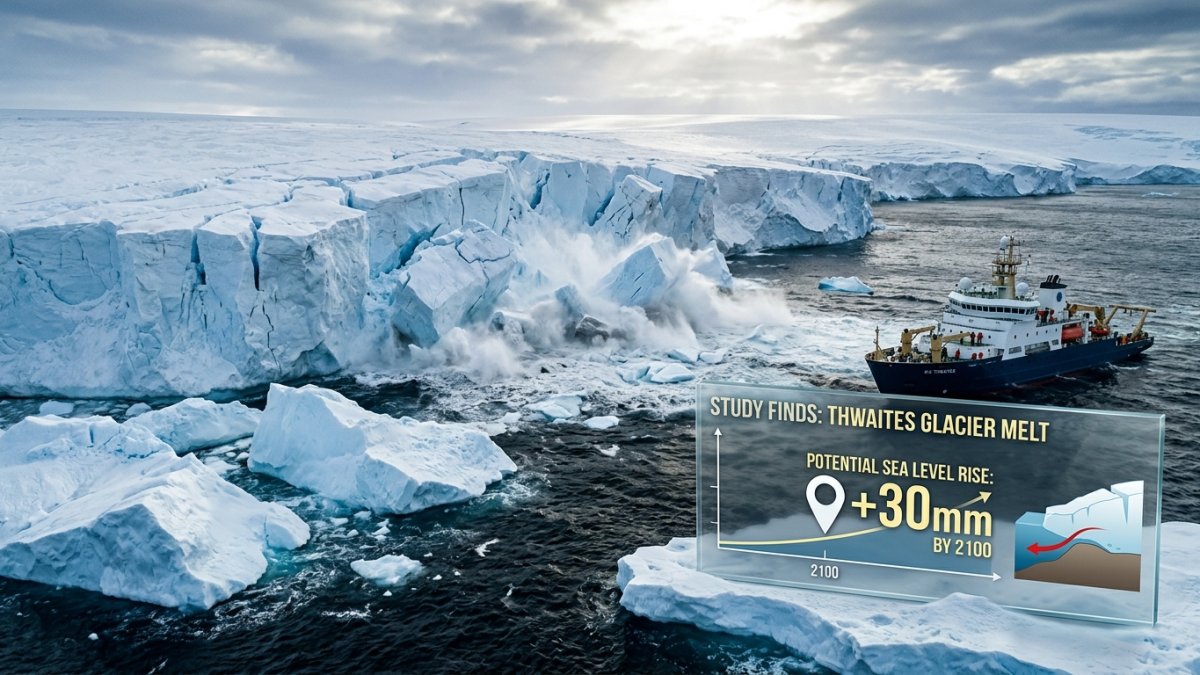
A new study suggests that Antarctica’s Thwaites Glacier could contribute as much as 30 millimetres to global sea levels by 2100, roughly twice the amount in current estimates. The researchers emphasize that the projection is a modelled scenario, not a prediction that the glacier will collapse by that date.
Thwaites spans about 192,000 square kilometres in West Antarctica, an area comparable to Senegal. It currently accounts for around four percent of global sea-level rise. Estimates cited in the research put its ice loss since 2000 at more than one trillion tonnes, with roughly 50 billion tonnes lost each year.
The study, conducted by researchers at the University of California, Los Angeles, in collaboration with NASA’s Jet Propulsion Laboratory, focuses on how ocean water interacts with the glacier where grounded ice meets floating ice. The model describes tides lifting and lowering the ice, allowing relatively warm seawater to move farther beneath it and intensify melting.
That process could speed the glacier’s separation from the underwater Mouginot Ridge, a feature that currently helps stabilize it. The researchers estimate a 60 percent chance of that “unpinning” occurring by the end of the century. They also calculate the potential 30-millimetre sea-level contribution under a scenario without additional warming, underscoring that the result depends on model assumptions and needs further study.
Scientists warn against interpreting the findings as an imminent collapse forecast. The glacier’s retreat has been monitored for decades, and separate modelling indicates that ice loss may continue for at least 150 years, even under unusually strong ocean cooling. Because Thwaites helps hold back a much larger part of the West Antarctic ice sheet, changes there matter for long-term coastal risk worldwide.